

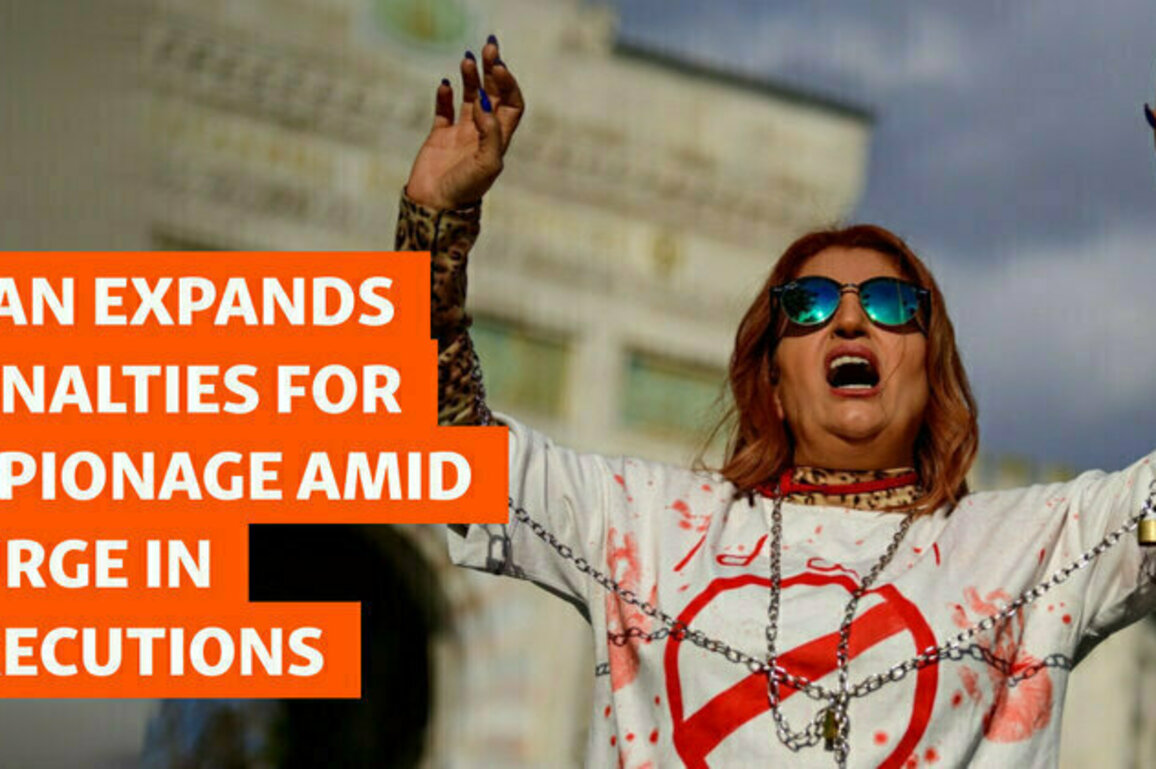
Just days after UN human rights experts decried a dramatic escalation in executions in Iran, the powerful Guardian Council approvedharsher sentencesfor spying and collaboration with Israel and the United States.
A spokesman for the Guardian Council, Irans constitutional watchdog, announced the decision on October 1 following months of back-and-forth with parliament over amendments.
This announcement comes soon after a UN panel revealed that Iranian authorities haveexecutedover 1,000 people since the start of the year -- a figure that Amnesty Internationalcalledthe most in at least 15 years.
SEE ALSO:
Iran's Executions Reach Highest Level In Decade
With an average of more than nine hangings per day in recent weeks, Iran appears to be conducting executions at an industrial scale that defies all accepted standards of human rights protection, UN experts said.
The panel reported that 10 people were executed on espionage charges this year, with eight carried out since June 13, when Israel launched a 12-day war against Iran. Since the reports release on September 29, Iran executed another individual for allegedly spying for Israel.
Nobel Peace Prize winner Shirin Ebadi said the authorities main goal is to display the Islamic republics violent face.
They want to intimidate the public so they dont exploit the political establishments weakness by taking to the streets, she told RFE/RLs Radio Farda.
In a stark warning, Ebadi said, Peoples lives have become tools for the survival of the ruling establishment.
Vague Language In Espionage Law
Since parliament introduced the bill in June, legal experts and human rights groups have warned that its vague wording and harsh penalties risk arbitrary accusations and mass executions, including for offenses that previously carried lighter sentences or werent classified as espionage.
Following final amendments, the law assigns the Supreme National Security Council (SNSC) the authority to identify "hostile states and groups," while the Intelligence Ministry lists specific "hostile networks."
SEE ALSO:
Rising Number Of Iranian Women Sentenced To Death Amid Surge In Executions
Any "intelligence activity, espionage, or operational action" for these hostile entities carries the death penalty and property confiscation. The law explicitly labels the US and Israel as "hostile states," with the SNSC identifying others.
It also states that, except for the death sentence, no other punishments are subject to appeal.
Grossly Unfair Trials
Amnesty Internationals report highlights that Revolutionary Courts, handling national security and drug-related cases, lack judicial independence and impose harsh penalties like death sentences after grossly unfair trials.
Ebadi argued that harsh punishments such as the death penalty have failed to curb drug smuggling.
Instead of cruel punishments, authorities should address the root causes driving people to commit drug offenses, she said, noting such crimes flourish in neglected, underdeveloped areas.
The problem is the establishments failure to fulfill its responsibilities. Instead, it uses inhumane punishments to spread terror, said Ebadi, who won the Nobel Peace Prize in 2003.
Embedding Death Penalty Into The Culture
Iranrankssecond globally in annual executions, behind only China.
Ebadi said the Islamic republic has tried to normalize the death penalty since coming to power after the 1979 revolution, even conducting public executions to embed it into the culture.
People would line up and bring their children, she recalled about the early days. But thats no longer the case.
She insisted that as long as the current regime governs, there is no way that the death penalty will be abolished.
So, if you ask what must be done, Id say we need to work toward ending the Islamic republic, Ebadi concluded.